 EN
EN English
 中文简体
中文简体 Español
Advanced Humanoid Robots: An Analysis of End-to-End Material Technology Solutions
1. Sensing & Vision
| Components | Recommended materials | Key Technical Parameters | Key Advantages and Application Logic |
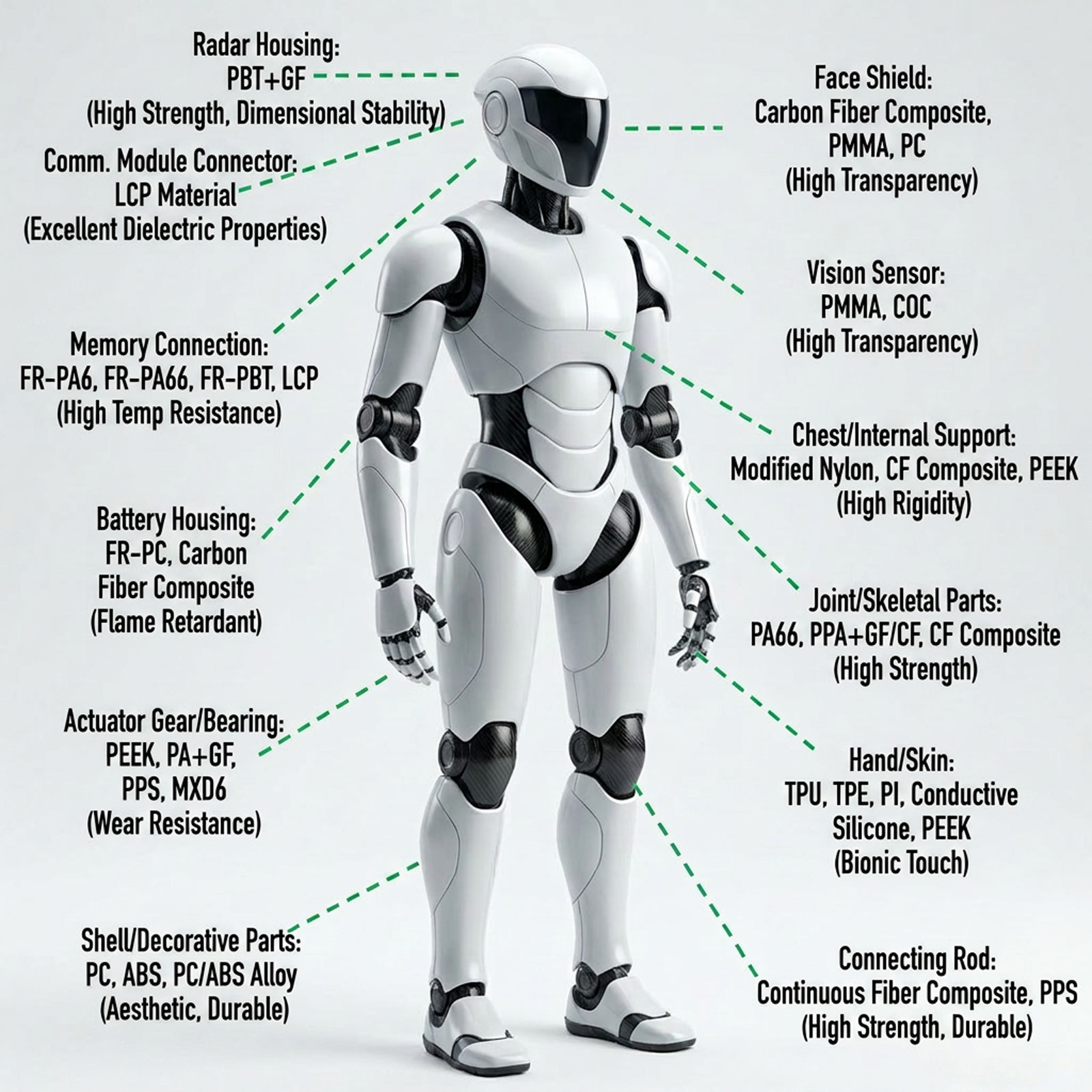
| Radar Housing | PBT + 30% GF | Modulus of elasticity: 8500–9500 MPa | Low signal attenuation and high dimensional stability: PBT has an extremely low moisture absorption rate, ensuring that the radar does not undergo dimensional shifts even in humid environments, thereby guaranteeing scanning accuracy. Glass fibre reinforcement (GF) enhances rigidity, preventing vibration interference during high-speed movement. |
| Water absorption: <0.05% | |||
| Face Shield / Vision | PMMA, COC, PC | Light transmittance: 90%–92% | Optical-grade clarity and impact resistance: PMMA offers optimal transparency; PC provides bulletproof-grade impact protection; whilst COC features an extremely low birefringence, making it suitable for high-precision vision sensors and reducing image distortion. |
| Refractive index: 1.49–1.58 |
2. Structural Skeleton
| Components | Recommended Materials | Key Technical Parameters | Core Advantages and Application Logic |
| Chest/Support | PEEK, modified nylon, CF composites | Specific strength: Extremely high | Extreme Weight Reduction and High Load Capacity: PEEK is the ‘gold standard’ among plastics, offering strength comparable to aluminium alloys but at half the density. The modulus provided by carbon fibre composites (CF) ensures that robotic skeletons do not undergo elastic deformation during complex movements. |
| Heat deflection temperature: >160°C | |||
| Connecting Rod | PPS, continuous fibre-reinforced composites | Tensile strength: 150–220 MPa | Long Service Life and High Dynamic Response: Linkages must withstand millions of reciprocating movements. PPS offers excellent chemical resistance and rigidity, whilst continuous fibre reinforcement confers a fatigue life comparable to that of metal. |
| Fatigue limit: Extremely high |
3. Actuation & Motion
| Components | Recommended Materials | Key Technical Parameters | Core Advantages and Application Logic |
| Actuator Gears/Bearings | PEEK, PPS, MXD6+GF | Coefficient of friction (dry friction): 0.15–0.25 | Self-lubrication and Extremely Low Wear: In precision joints where frequent lubrication is impractical, the self-lubricating properties of PEEK and POM ensure silent operation. MXD6 offers extremely high modulus and surface finish, making it suitable for precision gear forming. |
| Hardness: Shore D 85+ | |||
| Joint Parts | PPA+GF/CF | Coefficient of linear thermal expansion (CLTE): Similar to aluminium alloy | Metal Replacement and High Precision: PPA (high-temperature nylon) possesses extremely high strength, and its coefficient of linear expansion matches that of metal parts, ensuring that joints do not seize mechanically when expanding due to heat. |
4. Electronics & Power
| Components | Recommended Materials | Key Technical Parameters | Core Advantages and Application Logic |
| Battery Housing | FR-PC (flame-retardant PC), carbon fibre composites | Flame retardancy rating: UL94 V-0 (1.5 mm) | Safety, Flame Retardancy and Electromagnetic Shielding: Flame-retardant PC is essential for electrical safety. Carbon fibre composites not only reduce weight but also provide a degree of electromagnetic interference (EMI) shielding, preventing battery radiation from interfering with sensors. |
| Impact strength: High | |||
| Connectors | LCP (liquid crystal polymer) | Melt flow rate: Extremely high | Miniaturisation and High-Frequency, High-Speed Applications: LCP’s excellent flow properties enable the moulding of ultra-thin, precision connectors with wall thicknesses as low as 0.1 mm; it is also resistant to the high temperatures of reflow soldering, making it a core material for wiring in robotic ‘brains’. |
| Solder heat resistance: 280°C+ |
5. Interaction & Skin
| Components | Recommended Materials | Key Technical Parameters | Core Advantages and Application Logic |
| Dextile Hand/Skin | TPU, TPE, conductive silicone | Shore hardness: 10A–50A | Simulated Tactile Sensation and Multifunctionality: TPE/TPU offers a skin-like texture, is wear-resistant and easy to clean. Conductive silicone, incorporating conductive carbon black or silver powder, can impart pressure-sensing capabilities (tactile feedback) to the material. |
| Chemical resistance: Excellent |
1. Parametric marketing: On product detail pages, do not simply state ‘high strength’; instead, specify concrete metrics. For example: ‘PEEK – Tensile strength up to 100 MPa, 50% weight reduction compared to aluminium’. Such technical data is more likely to attract overseas R&D buyers.
2. Eco-premium: If your materials are bio-based or recycled (PCR), be sure to highlight this in the robot housing section. Eco-friendly materials are currently a key focus for leading robotics companies (such as those in the supply chains for the Tesla Bot and Boston Dynamics).
3. Flame Retardant Certification: For electronic component materials, clearly state UL94 V-0 certification, as this serves as the ‘entry ticket’ for accessing European and American markets in cross-border trade.