 EN
EN English
 中文简体
中文简体 Español
Consumer Electronics and 5G Communications: An In-Depth Analysis of Materials Technology
1. Precision Structures and Connections (Precision & Connection – The Core of Miniaturisation)
| Component Name | Recommended Materials | Key Technical Specifications | Key Benefits and Solutions to Pain Points |
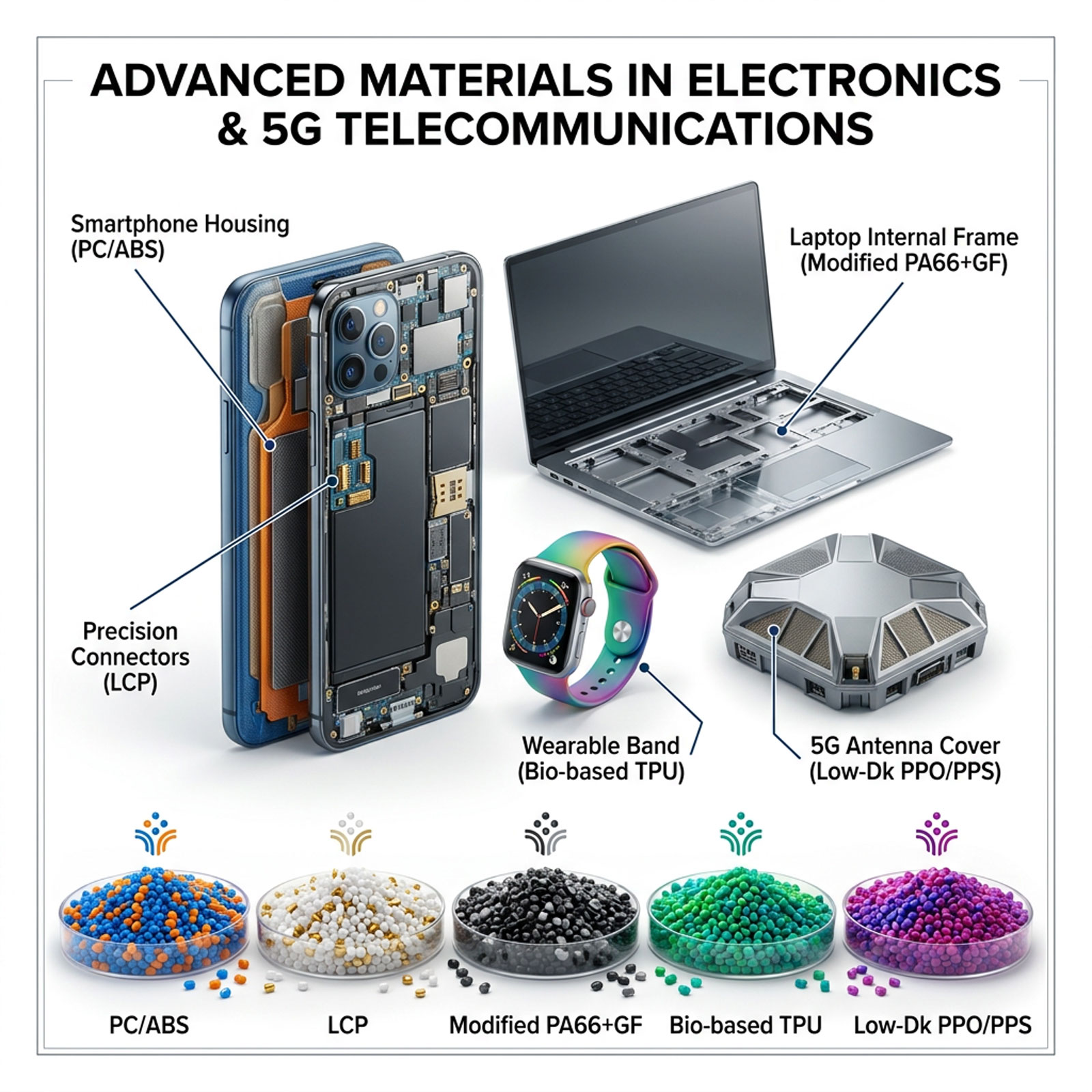
| Precision Connectors | LCP (Liquid Crystal Polymer) | Melt flow rate: Very high | Ultra-thin walls, high precision: LCP enables the moulding of micro-connectors with wall thicknesses as thin as 0.1 mm, whilst withstanding the high temperatures of SMT reflow soldering without deformation, making it essential for the wiring of a smartphone’s ‘brain’. |
| Solder heat resistance: ≥280°C | |||
| Internal Frame | PA66 + 50% GF / PPA | Flexural modulus: ≥15,000 MPa | Replacing steel with plastic, ultimate rigidity: Enhanced with high-fibre-glass-filled (GF) reinforcement, it offers strength approaching that of metal, supporting the internal structures of ultra-thin laptops and mobile phones whilst reducing the overall weight of the device. |
| Dimensional stability: Excellent |
2. Housing and Antenna System (Housing & 5G Antenna – Signal Quality and Aesthetics)
| Part Name | Recommended materials | Key Technical Specifications | Key Benefits and Solutions to Pain Points |
| Smart Device Housing | PC/ABS or special-purpose PC | Impact strength: ≥500 J/m | Balancing impact resistance and aesthetics: PC/ABS combines the toughness of PC with the machinability of ABS. Not only can it withstand the impact of accidental drops, but it also allows for a range of high-end finishing processes such as spray painting and electroplating. |
| Surface gloss: Very high | |||
| 5G Antenna Cover | Low-Dk/Df PPO/PPS | Dielectric constant (Dk): ≤2.8 | Signal Transparency and Low Attenuation: 5G high-frequency signals are highly susceptible to obstruction. Modified PPO/PPS features an extremely low dielectric constant, ensuring virtually no signal attenuation during transmission, making it the material of choice for 5G base stations and mobile phone antenna brackets. |
| Dielectric loss (Df): ≤0.002 |
3. Wearables (Wearables – Skin-friendly and durable)
| Part Name | Recommended materials | Key Technical Specifications | Key Benefits and Solutions to Common Issues |
| Wristband/Soft Rubber Component (Wearable Band) | TPU / TPE / Fluorinated rubber | Shore hardness: 40A–80A | Skin-friendly texture, sweat- and oil-resistant: causes no irritation even with prolonged skin contact. TPU offers excellent abrasion and tear resistance, and will not discolour or degrade even in sweaty, active environments. |
| Biocompatibility: Tested and approved |